Mary awakens without her memory and escapes the hospital
Other PeopleMary awakens without her memory and escapes the hospital in a sequence that turns disorientation into movement: unable to recover a personal past or understand the institution around her, she reads its corridors and people for clues, removes the devices that impede her, and gets outside. The episode establishes both the severity of her amnesia and the resourcefulness with which she responds to immediate obstacles. Her escape does not restore her identity; it leaves her alive and moving through a world she cannot yet explain.
Awakening and Disorientation
Mary Lamb / Amy Hide’s first response on regaining consciousness is relief that she is all right, accompanied by a sense that time is starting again. Someone close by asks whether she is all right, and she nods and answers yes. The brief exchange confirms her immediate awareness, but supplies no history: she cannot connect the present experience to a remembered self.
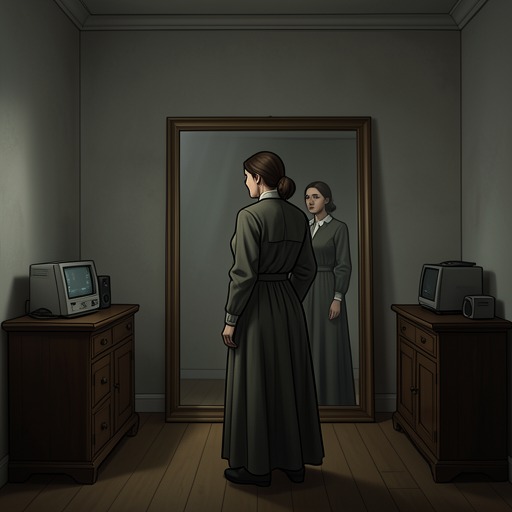
The institution presents itself to her through a stark division between white-clad keepers and smaller people in varied robes, who are being carried or led. She recognizes herself among the vulnerable group without knowing why she is there. In a narrow room, she searches her mind for clues and finds what seems an endless emptiness. Her uncertainty extends beyond her own identity: she cannot tell how long she is expected to stay, whether someone will come for her, or whether the place is dangerous. The gap between the keepers’ apparent authority and her inability to understand their intentions makes even waiting uncertain.
Her first hours are therefore organized around questions rather than recovered memories. She tries to make sense of the room and the people in it, but has no dependable past with which to interpret them. The narration presents this not as a simple blank in an otherwise stable account of her life, but as a disruption of the means by which she could recognize herself and judge her circumstances. The immediate task becomes practical: find a way through the institution before anyone directs her again.
Finding a Way Out
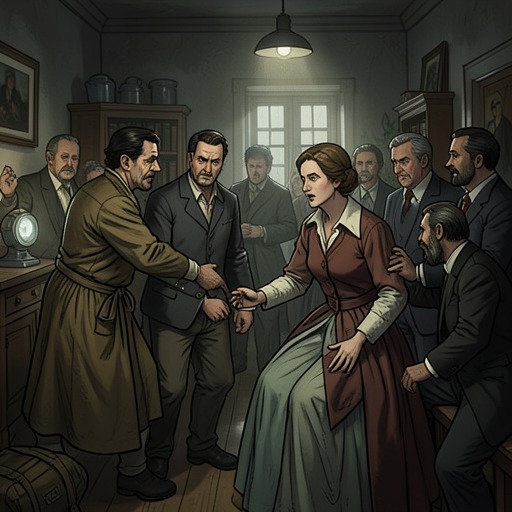
Mary works out how to open the narrow room’s door. Once outside, she moves towards the keepers and the people they guide, following the light along the walls. The passage opens into a crowded area where people stand in grief or furtiveness, lie on tables, or call out as keepers take them away. A bloodied person is shouting in the middle of the floor. The scene is disordered, but Mary avoids the pockets of distress and continues towards open double doors; no one stops her.
Her feet are fitted with heavy, curved extensions that make walking difficult. When she tries to move faster along a glass passage, the devices cause pain and check her progress. She pauses to examine them, discovers that they can be removed without much difficulty, and discards them. Two men carrying an empty hammock shout and frown at the machines left on the floor, but Mary does not turn back. The episode makes the restraints a concrete obstacle rather than an explanation of her confinement: she can remove them, but she still does not know who put them there or why.
Outside the Institution
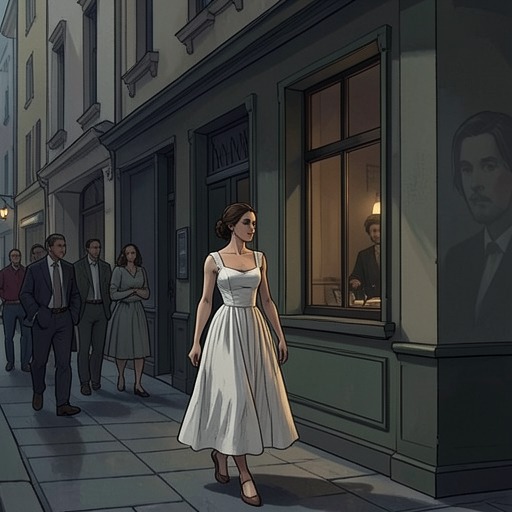
Crossing the threshold does not bring immediate safety or understanding. At first, the exterior seems to Mary like only a change in scale: people continue to move through tall, spanning passages, many of them appearing damaged, while others travel in trolleys along broad central lanes. The streets are filled with displays and symbols whose meanings are denied to her. People look at her, especially at her unprotected feet; she infers that others are expected to use devices and that being without them marks her as out of place. Even so, she keeps moving because movement is what the surrounding world demands.
This contrast gives the escape its limited but decisive success. Inside, Mary is one of the vulnerable people being led through a system she cannot read. Outside, she is no longer being physically directed by the keepers, but she remains exposed to a public order whose customs and signs are equally opaque. Freedom begins as the ability to leave and continue under her own power, not as a recovered account of who she is or a settled sense of where she belongs.
The Park and the Continuing Amnesia
Later, Mary wakes on a rise in London parkland beneath a silver birch. The narrative fixes the scene at 7:29 in the morning and 51 degrees Fahrenheit. She does not initially know where she is or how she arrived there. She struggles to understand memory as something she has lost, with her recollection stopping in mist around the previous day. She can establish that she has not died, but cannot tell whether her memory is gone for good or might return.
The park scene marks a consequence of the escape rather than a cure for it: Mary has reached the open air and slept, yet wakes still without a continuous past. At the same time, she discovers a capacity that the earlier scenes of mental emptiness might have obscured. She can name birds, distinguish sparrows from a hooded crow, and connect them loosely with dogs and a cat she encountered the day before. These names do not give her a coherent identity or explain how the world fits together, but they show that her loss is not total. She can recognize particulars even when the relations among them—and her own place among them—remain unsettled. The event thus ends on a modest double condition: personal memory is still absent, while attention and the ability to name the world have begun to work again.